

Copilot Didn't Leak Your Data. Your SharePoint Permissions From 2019 Did.
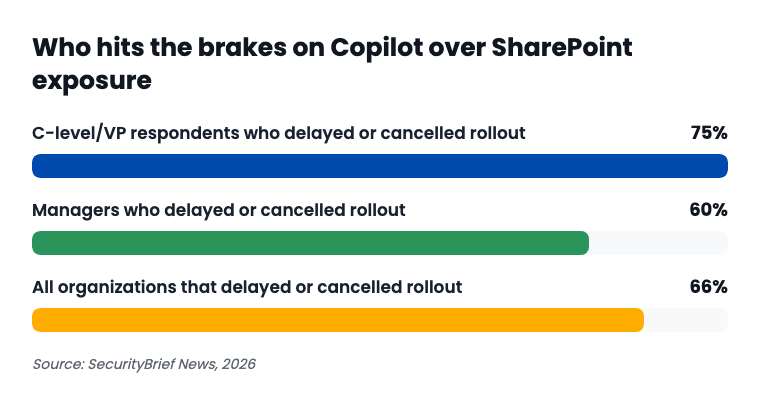
Copilot SharePoint oversharing isn't a new leak. It's an old one, now searchable. Copilot doesn't grant any employee new access. It reads through Microsoft Graph and respects whatever permissions already exist, which means a folder shared to "Everyone except external users" back in 2019 is now one plain-English question away from being read by anyone in the building. Sixty-six percent of organizations have delayed or cancelled a rollout over exactly this.
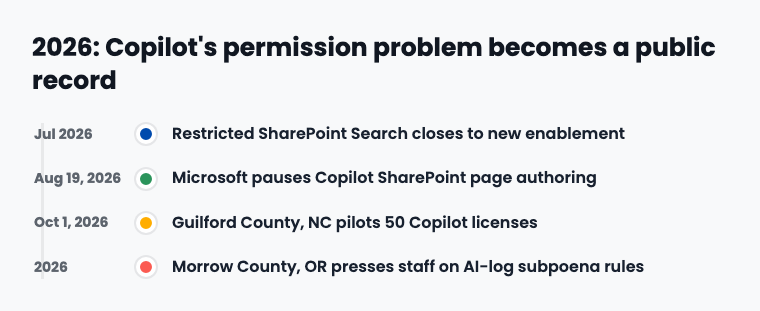
Guilford County, North Carolina didn't wait to find out the hard way. The county piloted 50 Microsoft 365 Copilot licenses starting October 1, 2026, at roughly $18,450 a year, about $30.75 per seat per month. That's a real, budgeted line item now sitting next to a governance question nobody had to answer five years ago: who can see what, and who's watching who looked.
The mechanic, stated plainly
Copilot is not the vulnerability. The vulnerability was always there, sitting quietly in SharePoint, Teams, and OneDrive permission settings that nobody revisited after the project that created them wrapped up. EPC Group, which runs Copilot-readiness audits for a living, reports finding an average of 150 to 300 overshared SharePoint sites per enterprise tenant. Each one is a site where access was granted broadly, once, for a reason nobody remembers, and never narrowed back down.
Before Copilot, that overshare sat there mostly harmless. Finding the HR compensation file inside it required knowing it existed, knowing where to look, and clicking through a folder structure built by someone who left the department three reorganizations ago. Copilot removes all three barriers at once. Ask it "what's the bonus structure for managing directors," and if that document lives anywhere Copilot can reach, it answers. No clicking required. We've written before about Copilot making documents easier to draft, not easier to find. This is the flip side: a tool good at surfacing content surfaces all of it, including what should've stayed narrow.
Microsoft noticed too
On August 19, 2026, Microsoft paused the rollout of Copilot-powered SharePoint page authoring, tracked internally as MC1282683, without publishing a detailed technical reason. A month earlier, in July, the stopgap tool agencies had been using to wall off sensitive sites, Restricted SharePoint Search, stopped accepting new enablement. It's been replaced by Restricted Content Discovery, a site-level toggle in the SharePoint admin center. Read between those two dates and the pattern isn't subtle: even Microsoft is still working out how to contain a problem its own product made instantly visible.
And the delay data splits in a way that should get your attention. Seventy-five percent of C-level and VP respondents have delayed or cancelled a Copilot rollout over SharePoint exposure concerns, compared to 60% of managers. The people who approve the budget are more nervous than the people who'd actually type the questions. That's not usually how adoption resistance works.
Higher ed has its own version of this
Universities run on decentralized SharePoint governance by design. Every college, every department, every grant-funded center sets up its own sites with its own sharing defaults, and almost nobody audits them centrally. Orchestry frames the readiness question for higher ed directly: before an institution asks how fast it can roll out AI, it needs to ask whether its Microsoft 365 tenant can survive the question being asked at all. A provost's office running Copilot against twelve years of departmental sprawl isn't rolling out a chatbot. It's running a discovery process on its own filing cabinets.
This is already a records question, not a hypothetical
San Francisco deployed Copilot Chat for city employees starting July 14, 2025. By April 2026, journalists and researchers had filed a California Public Records Act request asking how that deployment actually gets used. Morrow County, Oregon went further: county commissioners pressed staff, on the record, about whether AI interaction logs are retained indefinitely and who decides if those logs get released under subpoena or a public-records request. Nobody had a clean answer. Arcata, California didn't wait for one either. The city council adopted a specific AI use policy on July 15, 2026, covering privacy, review, and disclosure, because no off-the-shelf governance framework existed to borrow from.
These aren't abstract AI-ethics debates. They're the same records-retention and FOIA obligations your agency has handled for decades, now attached to a tool that reads faster than any human ever could.
What auditors ask
Not "is your AI tool secure," but "show me who accessed this file, when, and what permission let them."
What permission-aware search actually fixes, and what it doesn't
Here's the honest version, not the sales version. Keyspider's workplace search mirrors the same permissions your source systems already enforce, the same way Copilot does. If a SharePoint site is overshared, a permission-aware search layer inherits that overshare too. No search tool fixes a bad access control list sitting underneath it. That's an audit problem, not a search problem, which is exactly why we built a SharePoint permission audit checklist as a companion to this post instead of pretending search alone solves it.
What permission-aware search adds on top is narrower, and it's real. Real-time indexing means that once your team fixes a permission, the correction shows up in search results within minutes instead of waiting on a nightly crawl. And a full audit trail of searches and result clicks, across every connected system rather than just the one Copilot happened to be reading from, gives you a direct answer to the Morrow County question: who looked at what, and when, across SharePoint, Drive, Confluence, and everything else your workplace search deployment touches. That's not a hypothetical feature. It's the same documented audit logging we cover in detail elsewhere for institutional-knowledge risk generally.
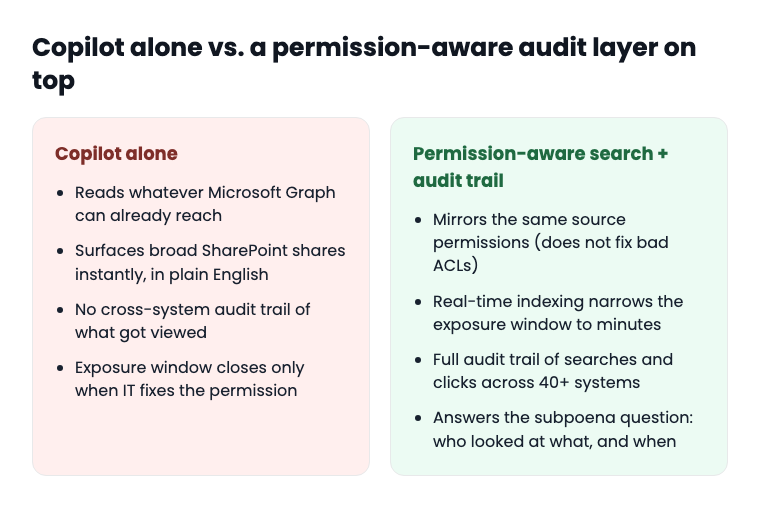
None of this replaces the permission audit. It just means the gap between "we fixed it" and "search reflects that" shrinks from days to minutes, and every lookup leaves a record your records officer can produce. For the longer version of where we draw that line, here's why agencies and universities pick Keyspider anyway.
Four questions to ask before anyone turns Copilot on
Questions to ask vendors
- Can you show us, today, every SharePoint site shared to "Everyone" or "Everyone except external users"?
- If we fix a permission tomorrow, how long until search results reflect that fix?
- Can you produce a log of who searched for and clicked on a specific document, across every connected system, not just one?
- Who owns the oversharing audit: your team, ours, or a third party we haven't hired yet?
Related reading
Got Copilot on the roadmap? Book a demo and we'll show you what a permission-aware audit trail looks like against your own SharePoint, Drive, and Confluence content.
Frequently asked questions
Does Copilot create new security vulnerabilities in SharePoint?
No. Copilot reads through existing permissions via Microsoft Graph. The vulnerability is pre-existing overpermissioning that Copilot makes instantly discoverable in plain English instead of requiring manual folder-hunting.
How many SharePoint sites are typically overshared in a government or university tenant?
EPC Group's Copilot-readiness audits find an average of 150 to 300 overshared sites per enterprise tenant. Decentralized SharePoint governance, common in both county agencies and universities, tends to push that number higher.
Can permission-aware search fix bad SharePoint permissions?
No search layer fixes a misconfigured access control list underneath it, including Keyspider's. Permission-aware search mirrors existing permissions faithfully; narrowing the exposure window and logging access still requires fixing the ACL itself.
What does a records officer need if AI search logs get subpoenaed?
A full audit trail showing who searched for what, when, and across which systems. That's a documented logging capability, separate from whether the AI chat conversation itself is retained, and it's worth confirming directly with any vendor before deployment.
Is this just a government problem?
No. A Hamilton-region, Ontario manufacturer paused its Copilot rollout for 11 weeks in early 2026 over the same oversharing concern. Government and higher ed face it with an added layer: public records law.
Ready to see it in action?
Book a demo and we'll configure Keyspider on a live sample of your content, within 48 hours.
Book a Demo