

Microsoft Spent Billions on Copilot. 3.3% of Licensed Users Pay to Use It.
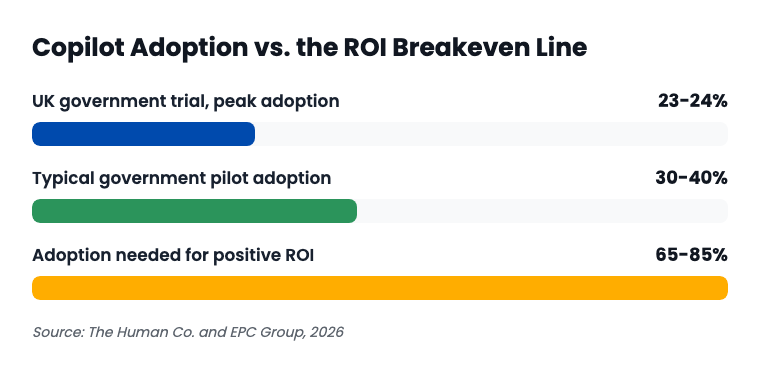
Microsoft Copilot's adoption rate sits near 3.3% of the 450 million-plus Microsoft 365 users who technically have access to it, and most government pilots land closer to 30-40% active use, well under the 65-85% needed to justify the license cost. If your agency is weighing whether to expand Copilot seats next fiscal year, that gap between "licensed" and "used" is the number to model first, not the sales deck.
Guilford County, North Carolina didn't theorize about this. It piloted 50 Microsoft 365 Copilot licenses starting October 1, 2026, at an annual cost of roughly $18,450. That works out to about $30.75 per user, per month. Fifty seats. One county. A real, dated, board-approved number, not an analyst's projection.
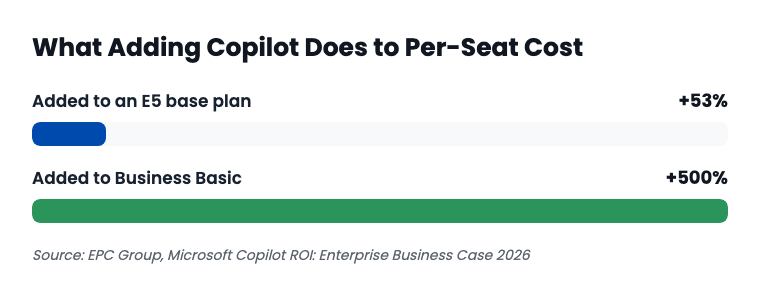
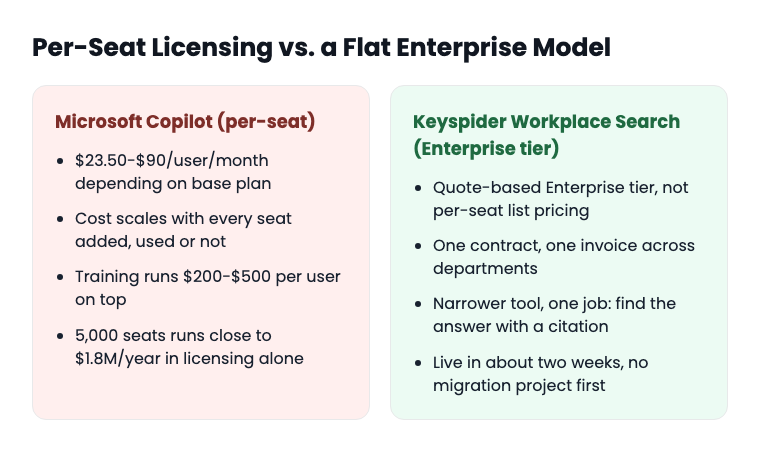
Scale that math up and the picture gets less comfortable. A 5,000-seat deployment runs close to $1.8 million a year in licensing alone, before a single hour of training or change management. And Microsoft raised Copilot pricing again effective July 1, 2026, with blended per-seat costs now running $23.50 to $90 a month depending on the base plan underneath it. Layer Copilot onto an E5 license and per-user cost climbs 53%. Layer it onto Business Basic and it climbs 500%.
The Microsoft Copilot Adoption Rate Nobody Puts in a Slide Deck
Here's the part procurement officers should ask about directly, because it rarely shows up unprompted. The UK government ran a 20,000-user Copilot trial and peaked at 23-24% adoption. Only 8% of employees prefer Copilot over ChatGPT or Gemini when given a choice. Four complaints repeat across the enterprise market: low voluntary adoption, hallucination risk in compliance-sensitive workflows, security exposure amplified by permissions nobody cleaned up first, and a persistent gap between license cost and actual return.
That third one matters more than it sounds. Copilot doesn't grant new access, it retrieves through whatever permissions already exist, so a SharePoint site shared to "everyone except external users" back in 2019 becomes instantly findable the moment Copilot can see it. EPC Group's readiness audits find an average of 150-300 overshared SharePoint sites per enterprise tenant, and fixing that before go-live runs $50,000 to $150,000 depending on tenant size. Our SharePoint permission audit checklist covers that cleanup work if security review is what's actually slowing your rollout.
Procurement tip
Ask your Copilot rep for the adoption rate at your agency's exact seat count and base license tier, not an enterprise-wide average. The gap between E5-based and Business Basic-based deployments is wide enough to change your whole budget case.
Why Adoption Stalls: The Training Burden
Training alone runs $200 to $500 per user. Change management eats another 5-10% of the deployment cost every year it's live, not just at launch. None of that shows up in the per-seat sticker price, and none of it is optional if you want staff to actually open the tool instead of ignoring it after the rollout email.
Part of why that burden is so heavy: Copilot is a general-purpose assistant. It drafts documents, summarizes meetings, writes code, and searches internal content, all inside one interface, which means every employee needs at least baseline fluency across all of those modes before the tool earns its keep. That's a lot of surface area to train against for a 2,000-employee agency with a 3-person IT shop.
The Real Copilot ROI Government Agencies Should Model
Even well-run Copilot programs model out to 1.5x-3.0x Year 1 ROI, not the order-of-magnitude return implied in a lot of vendor messaging. That's not a bad number, it's just a different number than the one usually pitched in the room. Model it against the 65-85% adoption threshold needed to hit even that range, then check it against your agency's actual pilot usage data, not the vendor's enterprise-wide average. None of this makes Copilot the wrong tool for drafting and summarizing. It means a general-purpose assistant and an internal search tool solve different problems, and budgeting for them identically is where agencies get burned.
A Narrower Tool Carries a Narrower Training Burden
Keyspider's Workplace Search exists for one job: an employee asks a plain-English question and gets an answer with a citation, pulled from across SharePoint, Drive, Confluence, ServiceNow, and the other systems staff already touch. It doesn't draft a board packet or write code, and that narrower scope is why the training burden drops. One interaction pattern to learn, not five.
We don't have a published Keyspider-specific adoption percentage, and we're not going to invent one to win an argument. What we can point to directly: deployment runs about two weeks with no migration or consolidation project first, and agencies running it report saving staff 30-45 minutes a day they used to spend hunting for documents, with ticket volume down 30-40% within 90 days. It also won't fix a SharePoint site overshared since 2019, no search layer does that, Keyspider included. What it does do is mirror whatever permissions the source system enforces and log every search and click across all 40-plus connected systems, a real answer to the records-retention and subpoena questions county commissioners are already asking out loud. If you're sizing up Workplace Search against a Microsoft-centric plan, that audit trail belongs on the comparison sheet.
On price, we won't pretend there's a published workplace-search-only number either. Workplace Search ships inside Keyspider's Enterprise tier, and like most of this market, that tier is quote-based. Check current pricing and ask for a number sized to your seat count, the same way you'd ask Microsoft for one. Agencies already buying through a cooperative vehicle, NASA SEWP V, NASPO ValuePoint, OMNIA Partners, TIPS, or Sourcewell, can run it through Carahsoft without opening a new procurement just to get a quote on the table next to Copilot's.
Model the adoption rate your agency actually gets, not the one in the enterprise average. The gap between those two numbers is where the budget case either holds up or doesn't.
For the procurement side of this, our RFP question bank for workplace search includes the specific cost and permission questions worth putting in writing before you sign anything, whether the vendor on the table is Microsoft or anyone else. It compares well against the cost-of-silos argument we've made before in our piece on workplace search ROI, which tackles the other side of this budget conversation: what it costs *not* to fix internal search at all.
Related reading
See how Keyspider Workplace Search prices out against the licensing math above. Book a demo and bring your current Copilot seat count.
Frequently asked questions
What percentage of Microsoft 365 users actually use Copilot?
Around 3.3% of the 450 million-plus Microsoft 365 users with Copilot access actively pay for and use it, based on 2026 enterprise adoption data. Government pilots commonly land in the 30-40% active-use range even after formal rollout.
How much does Microsoft Copilot cost per user per month?
Pricing effective July 1, 2026 runs $23.50 to $90 per user per month depending on the base Microsoft 365 plan, with per-seat cost increasing 53% on an E5 base and up to 500% on Business Basic.
What adoption rate does Copilot need to hit to justify its cost?
Industry modeling puts the breakeven range at 65-85% active adoption. Most organizations, including the government pilots reviewed here, land closer to 30-40%, which is why ROI often disappoints relative to the pitch.
Does a narrower internal search tool train faster than Copilot?
A tool scoped to one job, like answering "where is this document," has less surface area to teach than a general-purpose assistant covering drafting, coding, summarizing, and search at once. That's a reasonable inference from the training-cost data here, not a claim backed by a specific Keyspider-vs-Copilot study.
Is Microsoft Copilot worth it for state and local government?
It depends on what you're buying it to do. For drafting and summarizing, many agencies find real value. For "where is this document," the data above suggests a purpose-built search tool with a lower training burden and faster deployment timeline is worth pricing out separately rather than bundling into the same budget line.
Ready to see it in action?
Book a demo and we'll configure Keyspider on a live sample of your content, within 48 hours.
Book a Demo