

Four Governors, One Month, Four State AI Executive Orders: What Changes for Internal AI Tools in 2026
Three governors signed AI executive orders within about six months of each other in 2026, and one analysis of the pattern counted four governors issuing AI-related orders within a single week. None of them were about chatbots on a public website. They were about what happens when state employees open an AI tool at their desk.
California, Oregon, and Illinois each issued executive orders governing how state agencies buy and deploy AI tools for internal use, not just citizen-facing ones. The orders add new contracting language, safety-review criteria, and procurement checkpoints that touch any internal search or AI assistant your agency is evaluating right now.
If you're drafting an RFP this fiscal year, these orders aren't background noise. They're conditions of the contract.
What each order actually requires
| State | Order | Date | What it does for internal AI tools |
|---|---|---|---|
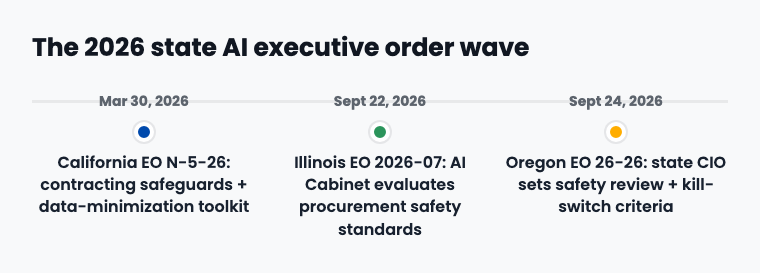
| California | EO N-5-26 | March 30, 2026 | Directs state agencies to give employees access to generative AI tools, but requires privacy and cybersecurity safeguards built directly into contracting language, an updated State Digital Strategy covering GenAI use cases, and a published data-minimization toolkit |
| Illinois | EO 2026-07 | September 22, 2026 | Creates an AI Cabinet tasked with evaluating AI safety standards specifically for state procurement |
| Oregon | EO 26-26 | September 24, 2026 | Has the state CIO developing third-party AI safety review criteria, including kill-switch requirements for vendor systems |
Read that table again and notice what's missing: none of the three orders ban internal AI tools. They regulate how agencies buy them. That's a very different problem for a procurement officer than an outright restriction, and it's one most existing vendor contracts weren't written to answer.
Procurement tip
Pull your current AI/search vendor contracts and search for the words "data minimization," "kill switch," and "safety review." If none of those phrases appear, your next renewal or RFP amendment is where they need to go in, not after the fact.
Why procurement teams can't treat this as IT's problem
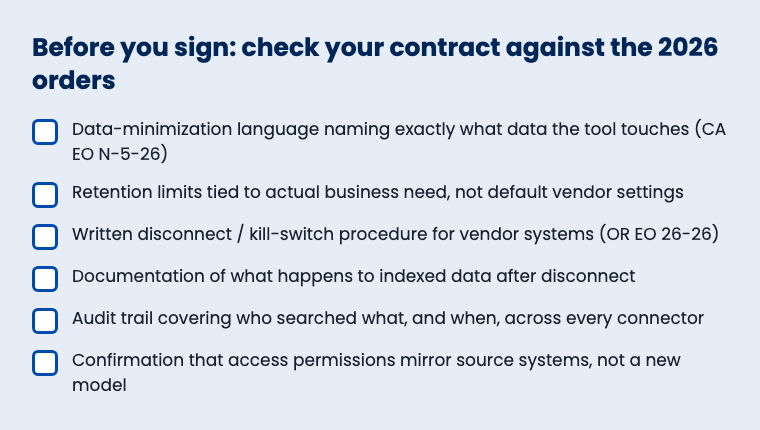
A data-minimization toolkit sounds like a technical artifact. It's actually a contracting document. California's order means your next AI vendor agreement needs language about what data the tool touches, how long it's retained, and why it needs that data at all. Oregon's kill-switch requirement is a different animal. Your contract has to specify how the state can shut a vendor's system down and what happens to indexed data when it does. Try writing that clause before asking the vendor whether their permission-aware search architecture even supports a clean disconnect.
Illinois took a third approach: stand up a cabinet-level body and let it write the standards before procurement moves. That buys time, but it also means any RFP issued before the AI Cabinet finishes its review is a guess at what the final bar will be.
None of this is theoretical for SLED IT shops running three-person departments against two thousand employees. NIST's AI Risk Management Framework gave agencies a voluntary structure for years. These orders start converting pieces of it into contract requirements, state by state, on different timelines. Keyspider's own playbook for the broader governance question lives in the state and local AI governance guide. This post stays narrower: what changes in your next contract.
What this means for the tool you're evaluating
A workplace search or internal answer engine touches exactly the data these orders worry about: HR records, case files, internal communications, procurement documents. Before you sign anything, get answers to three questions these orders now put on the table.
- 1Can the vendor show you a full audit trail of who searched for what, and when? That's the foundation of any data-minimization or safety-review conversation. Keyspider's platform brief documents full audit logging of searches and result clicks as a standard feature. For Oregon-style safety-review documentation, that's the evidence you'll be asked to produce.
- 2Does access actually mirror your existing permissions, or does the tool create a new attack surface? Role-based access that inherits permissions from the source system is a different compliance posture than a tool that re-indexes everything into its own access model.
- 3What's the actual disconnect procedure? Ask this directly, in writing, before Oregon's kill-switch language becomes a standard RFP clause everywhere else too.
What auditors ask
Not "does the vendor have AI." They ask who can see what, who looked at what, and what happens if you need to pull the plug. Build your RFP questions around those three things and the executive-order compliance follows naturally.
Contract vehicle mechanics matter too. If your agency buys through NASPO ValuePoint or a similar cooperative agreement, the base terms were likely negotiated before these 2026 orders existed. Don't assume the contract covers your state's new language automatically. Check the amendment process, and build the clauses your order requires into the task order or addendum you sign. State buyers can see how this maps to a live deployment on Keyspider's state government page.
The honest gap
No internal search vendor, Keyspider included, can promise full compliance with an order still being interpreted by your own state's procurement office. A vendor can hand you the documentation these orders actually ask for: audit logs, permission-mirroring architecture, a clear answer on data handling. The compliance determination stays where it belongs, with your agency's legal and procurement teams.
For the compliance language itself, Keyspider's internal search compliance checklist walks through CJIS, FERPA, and records-retention questions in more depth than this post can. And if you're building the RFP language these orders now require, the workplace search RFP question bank has the specific permission and audit-trail questions to ask any vendor, not just Keyspider.
Related reading
Ready to see how audit trails and permission-aware access map to your state's requirements? See Keyspider Workplace Search in action with a 30-minute demo built around your agency's specific contract language.
Frequently asked questions
Do these executive orders apply to AI tools already under contract, or only new purchases?
Each order is written differently. California's focuses on contracting language going forward and a published toolkit. Oregon's tasks the state CIO with review criteria that would logically apply at renewal. Check your state's order and your agency's legal interpretation before assuming either way.
Does a FedRAMP or StateRAMP authorization satisfy these requirements?
Not automatically. These orders cover data minimization, safety review, and operational controls like kill switches, not cloud-authorization frameworks. A vendor's compliance posture is a separate question from whether your contract language meets the order's specific requirements.
My state hasn't issued an AI executive order. Does any of this apply to us?
The pattern is accelerating. Three states moved in six months in 2026, and the pressure behind it, workforce AI adoption outpacing procurement policy, isn't unique to California, Oregon, or Illinois. Building audit-trail habits now costs less than retrofitting them under a deadline later.
What's the fastest way to see if our current vendor contracts would pass a safety review?
Start with the three questions in the "what this means for the tool you're evaluating" section above: audit trail, permission mirroring, disconnect procedure. If a vendor can't answer those in writing, that's your answer.
Where do NIST's AI Risk Management Framework and these state orders overlap?
The NIST AI RMF is voluntary federal guidance. These state orders turn pieces of that framework, like data minimization and safety review, into binding contract requirements at the state level, each on its own timeline.
Ready to see it in action?
Book a demo and we'll configure Keyspider on a live sample of your content, within 48 hours.
Book a Demo