

Gartner published its first-ever Magic Quadrant for Enterprise AI Search in October 2026. Eleven vendors, one newly named category, and a CIO somewhere right now trying to figure out what any of it means for the RFP sitting half-finished on their desk. If you're building a workplace search buyer's guide for your own evaluation, you're not early and you're not late. You're exactly on time, because the market just got its first formal scorecard and most procurement processes haven't caught up to what's on it.
The short answer: evaluate workplace search vendors on four things a demo won't show you unprompted: whether permissions are enforced at query time or batch-synced overnight, how many minutes pass between a document change and that change showing up in search, whether the vendor names your actual compliance requirement instead of saying "enterprise-grade," and whether you can see a real price before week six of a sales process. Score every vendor the same way, on the same sheet, before you sit through a second demo.
Reality check
Three vendors evaluated for this category in the past year are no longer the vendors they were when the evaluation started. One closed to new customers. One is deprecating the exact product line it just won an award for. One got folded into an acquirer's roadmap. Read the "status changes" section below before you shortlist anyone.
Why a workplace search buyer's guide needs a new chapter in 2026
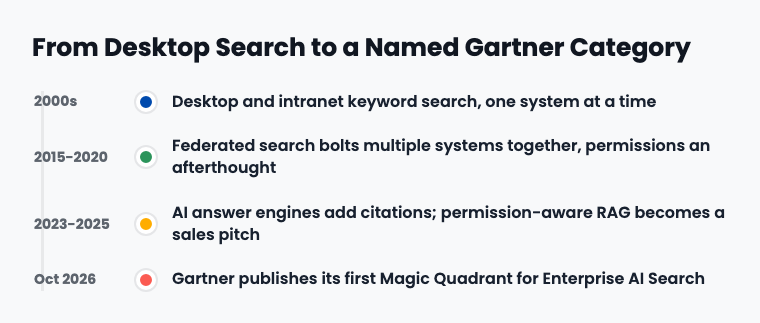
Enterprise search used to mean a search box bolted onto a SharePoint intranet, returning a list of file names and leaving you to guess which one had the right version. That's not what's being evaluated anymore. The category Gartner just named, Enterprise AI Search, assumes an AI-generated answer with citations, pulled from every connected system, filtered by what the asking employee is actually allowed to see. Gartner assessed 11 vendors for this inaugural Magic Quadrant. Elastic came out as the sole named Leader. IntraFind and Squirro landed as Niche Players. No other vendor earned a quadrant placement in the report's first run.
That's worth sitting with for a second. A brand-new analyst category, one Leader, and a field of competitors still sorting out where they land. If your last internal search RFP used criteria from three or four years ago, crawl speed, connector counts, generic "AI-powered" language, you're not evaluating against this year's bar. You're evaluating against 2022's.
The IT director feeling this pressure most directly is usually the one managing a state agency, county government, school district, or university where the old intranet search has quietly become unusable while nobody budgeted to fix it. Keyspider's Workplace Search exists specifically for that buyer: the employee who types a plain-English question and should get a direct answer instead of a list of forty file names, with the answer pulled only from systems and permissions that employee already has.
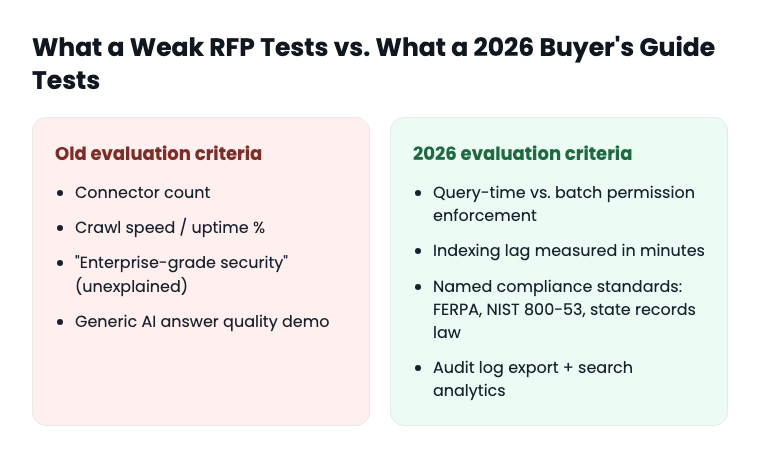
The four categories a real evaluation covers
A workplace search vendor comparison that only scores feature checklists will produce a tie. Every vendor in this space claims AI-generated answers, citations, and dozens of connectors. The differentiation lives one layer down, in how those claims hold up under a direct question.
| Evaluation category | What to ask | Why it separates vendors |
|---|---|---|
| Permission enforcement timing | Is access checked at query time or synced in a batch overnight? | A batch sync means a fired employee's access might still work for hours. Query-time checks close that gap. |
| Indexing lag | How many minutes between a document change and it appearing in search? | "Real-time" means nothing without a number. Ask for one in writing. |
| Named compliance fit | Does the vendor name FERPA, state records retention, or NIST 800-53 alignment, or just say "secure"? | Vague security language is the single biggest tell of an unprepared vendor response. |
| Pricing transparency | Can you get a comparable quote in days, or does every answer require a multi-week sales cycle? | G2 reviewers have flagged opaque, quote-only pricing across this category. You're not the only buyer frustrated by it. |
| Audit log usability | Can an administrator export search and click logs without vendor involvement, for a records request? | Government buyers need this for public records law. Most vendor marketing skips it entirely. |
| Deployment timeline, your systems | What's the actual timeline for your department count and your document volume, not a generic range? | "Typically 2-4 weeks" told to every prospect isn't a timeline. It's a sales line. |
Permission-aware RAG, retrieval filtered by access rights before an answer ever gets generated, has gone from differentiator to baseline requirement across 2026. Industry sources now describe it as the technical bar every vendor is expected to clear, not a premium feature to upsell. Keyspider's RFP question bank breaks these same categories into specific, scoreable questions you can drop straight into a procurement document, with the exact language to separate a vendor that built for query-time enforcement from one that's still batch-syncing permissions overnight and calling it real time.
Where the category actually stands: vendor status changes worth knowing before you shortlist
A vendor comparison written six months ago is already out of date in three places that matter.
Amazon Q Business closed to new customers on July 31, 2026. If your shortlist still includes it, confirm directly with AWS before you spend another hour in evaluation. The product's own public-sector security content named HIPAA, PCI, and ISO 42001 but never mentioned StateRAMP or CJIS, a gap that matters more for state and local buyers specifically, and the market exit makes the question academic for anyone not already a customer.
Elastic is deprecating its standalone Workplace Search product at version 9.0, in the same cycle it was named a Leader in Gartner's new Magic Quadrant. Sit with that tension for a moment, because it's genuinely strange. The analyst community just handed Elastic the top spot in a brand-new category, and Elastic's own roadmap is walking away from the packaged product that most buyers would associate with "workplace search" as a term. Elastic's path forward runs through building on raw Elasticsearch and its newer serverless and vector-search tooling, a heavier lift for an organization without a dedicated search engineering team. Worth a direct question in any demo: are you buying the award-winning platform, or the deprecated product it's replacing?
Dashworks no longer exists as an independent vendor. HubSpot acquired it, folded its retrieval technology into HubSpot Breeze, and sunset the standalone product. It still shows up in third-party "best of" roundups built on stale data. If a comparison chart you're reading lists Dashworks as an active option, that chart hasn't been updated recently, and you should wonder what else in it is stale too.
None of this means the other eight vendors Gartner assessed are static. It means a workplace search buyer's guide written in 2025 is not safe to reuse in a 2026 procurement cycle without a status check on every name in it.
Score where your organization sits before you score vendors
Before comparing vendors, place your own evaluation. Teams skip straight to vendor demos without agreeing internally on what "done" looks like, and it shows in scattered, inconsistent scoring across the committee.
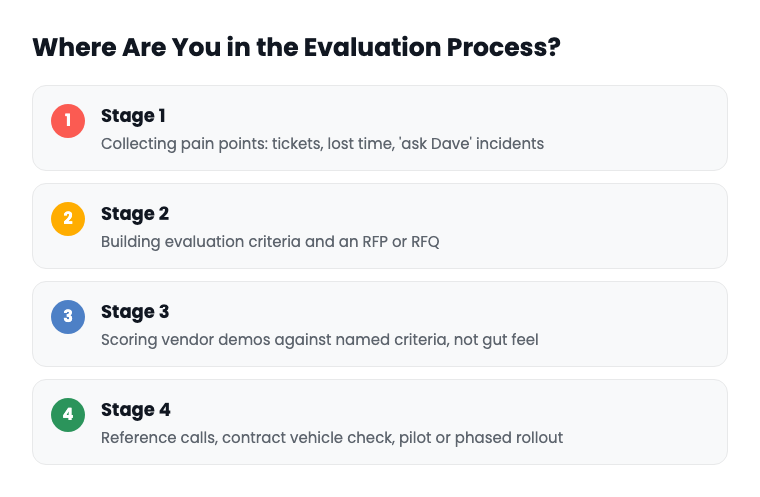
Stage 1 is informal: tickets about "where is this file," complaints about a scattered intranet, the one person everyone asks because nobody else knows where things live. Stage 2 is when those complaints become a written RFP or RFQ with defined criteria. Stage 3 is scoring actual vendor demos against those named criteria, not gut feel after a slick presentation. Stage 4 closes the loop: reference calls to real customers, a contract vehicle check so procurement doesn't stall for six weeks, and a pilot or phased rollout before a full commitment.
A committee that jumps from Stage 1 straight into vendor demos ends up scoring on vibes. The vendor with the best slide deck wins, which is exactly backward from the goal.
A six-question scorecard for the actual demo
Hand this to whoever's running point on your evaluation. Use it in every vendor meeting, same six questions, same order, every time.
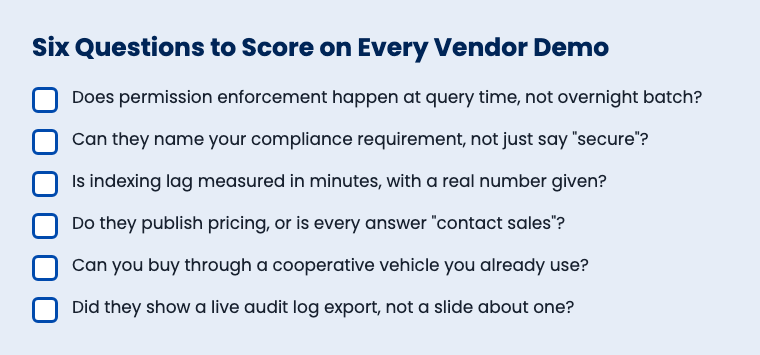
A vendor who answers all six with specifics, a number of minutes, a named standard, a visible audit export, scores far ahead of a vendor who answers all six with confidence and no numbers. Confidence is cheap in a sales meeting. Specificity isn't.
By the numbers: what Gartner's new category actually says
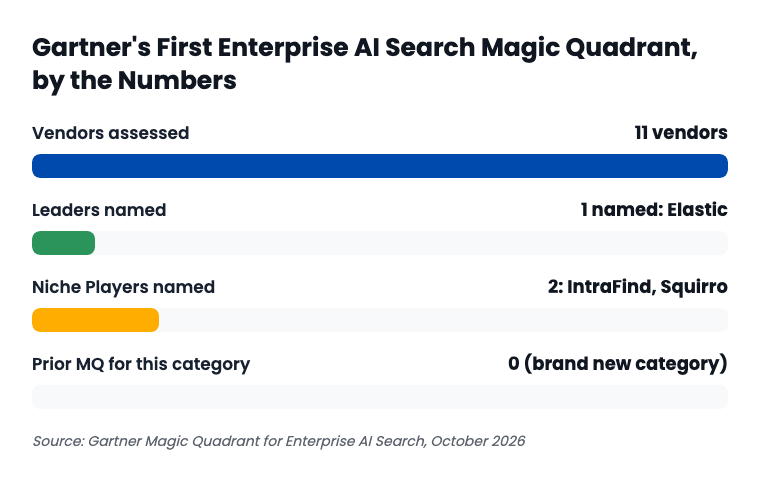
Eleven vendors assessed. One Leader. Two Niche Players. Zero prior Magic Quadrants in this exact category, meaning no vendor can claim a multi-year streak here, no matter what their press release implies. Gartner's new market category deserves its own read if you want the full breakdown of how the quadrant placements shook out and what criteria Gartner used to sort vendors into them.
What this means if you're already locked into Microsoft 365 licensing
A specific version of this evaluation question comes up constantly with government and higher ed buyers already paying for Microsoft 365: does Copilot's search layer solve the internal search problem on its own, or do you still need a dedicated workplace search platform on top of it?
The honest answer leans toward the second option, and the adoption numbers back it up. Microsoft Copilot rollouts are running well below projected usage across the enterprise market, with voluntary adoption frequently stalling near 20% even at organizations that bought seats for everyone. The adoption gap is its own story worth reading in detail, but the short version for a buyer's guide is this: licensing Copilot doesn't automatically mean your employees are finding answers faster. It means they have another tool sitting next to the ones they already weren't using consistently.
Higher ed has its own version of this evaluation
State agencies and universities both end up in the same buyer's guide conversation, but the pressure points differ. A university's internal search problem usually traces back to decentralized department IT, dozens of colleges and administrative units each running their own file shares and ticketing systems, with no institution-wide way to search across them. 2026 commentary in higher ed has reframed that fragmentation from a culture problem into an operational one: inconsistent student-facing information across departments isn't a quirky org-chart quirk anymore, it's a service failure that shows up in enrollment and retention metrics. A deeper look at how university data silos got this way is worth reading if your evaluation committee includes stakeholders from multiple colleges who don't normally sit in the same procurement meeting.
See where Keyspider scores on your sheet
Keyspider's Workplace Search was built around the exact criteria this guide walks through: permission enforcement that mirrors your source systems at query time, indexing changes reflected within minutes, full audit logging, and a path to purchase through cooperative vehicles your organization may already use. Enterprise pricing is quote-based; see Keyspider's pricing page for how the tiers break down, and the vendor comparison page for a side-by-side against other platforms in this category.
Related reading
Workplace Search RFP Question Bank
Turn these evaluation categories into specific procurement language.
Gartner Just Created a Market Category
The full breakdown of the inaugural Enterprise AI Search Magic Quadrant.
Microsoft Spent Billions on Copilot
What the adoption numbers actually show about Microsoft 365 Copilot as a search solution.
Government Digital Leader's Playbook
The companion evaluation guide for public-facing AI site search, if you're running both procurements at once.
Your University's Silos Aren't a Culture Problem
The higher-ed-specific version of the internal search problem.
Ready to see where Keyspider scores?
Book a 30-minute demo and score Keyspider against your own evaluation criteria, category by category, live.
Book a 30-Minute DemoFrequently asked questions
What's the difference between a workplace search buyer's guide and an RFP question bank?
A buyer's guide sets the evaluation framework, maturity stage, scoring categories, and vendor status changes you need to know about, before you write a single RFP question. The RFP question bank turns those categories into specific, scoreable language for the procurement document itself.
Does Gartner's new Magic Quadrant replace the old "insight engines" category?
It's a distinct, newly created category rather than a rename. Gartner's inaugural Enterprise AI Search Magic Quadrant, published October 2026, assessed 11 vendors against criteria built for AI-answer-generation search specifically, not the older keyword-and-facets insight engine model.
Should a state or local government buyer trust a vendor comparison that doesn't mention StateRAMP?
Be cautious of it. Several major vendors publish detailed federal-style compliance content, HIPAA, SOC 2, even FedRAMP language, while staying silent on StateRAMP and CJIS specifically. That silence matters more for state and local buyers than it does for private-sector ones, since StateRAMP and CJIS are the authorizations your agency is actually measured against.
How long should a workplace search vendor evaluation take, start to shortlist?
There's no universal number, but committees that skip Stage 1 (defining pain points) and jump straight to demos tend to take longer overall, because they end up re-running demos once they realize they scored inconsistently the first time. Define criteria first. It saves time later, not less now.
Is Elastic still a safe choice if it's deprecating standalone Workplace Search?
That depends entirely on whether your organization has the engineering capacity to build on raw Elasticsearch and its serverless and vector-search tooling going forward. Ask any vendor you're evaluating, including Elastic, to show you the actual product you'd be buying today, not the one being phased out.
Can we buy workplace search through a cooperative purchasing vehicle instead of running a full competitive RFP?
Often, yes, depending on your state and local purchasing rules. Keyspider is available through NASA SEWP V, NASPO ValuePoint, OMNIA Partners, TIPS, and Sourcewell, cooperative vehicles that have already run the competitive process on your behalf in many jurisdictions. Confirm specifics with your own procurement office before assuming it applies.